Removal, trimming, storm cleanup, and stump grinding across Florence and the Pee Dee. Written estimates before the work starts.
Call (555) 555-5555Or call — we answer. No obligation, honest advice.
The Pee Dee grows trees like it means it. Loblolly pines run up eighty feet and keep going, live oaks spread until they are over the roof, and sweetgums and water oaks fill in every older neighborhood from downtown Florence out to Timmonsville. It is genuinely good shade for most of the year, and then a storm spins up the coast or an ice event rides in from the west, and the pine leaning toward the kitchen becomes the only thing anybody can think about.
Three kinds of tree work show up around here. Older Florence neighborhoods have mature canopies that need regular attention, because a large tree that has never been pruned is not a safer tree. Newer subdivisions are hitting the age where builder-planted trees crowd the houses they were planted next to. And rural properties have pine stands, fence lines, and the long war with sweetgum. The species and the weather are what make this region its own job.
The approach is straightforward. Look at the tree, tell you honestly what it needs, put the estimate in writing, and do the work when we said we would. Cleanup and haul-off are part of a removal quote, not a line item that appears afterward. And sometimes the right answer is that the tree is fine and you should keep your money.
Most tree work is rigging and planning long before anything gets cut. A pine over a driveway comes down in a different order than the same pine in an open field, and the difference between those two plans is what protects your roof, your fence, and the neighbor's shed.
The site gets raked before we leave. Ruts, sawdust piles, and a yard full of chips are avoidable, and a job is not finished until the ground looks like we were never there.
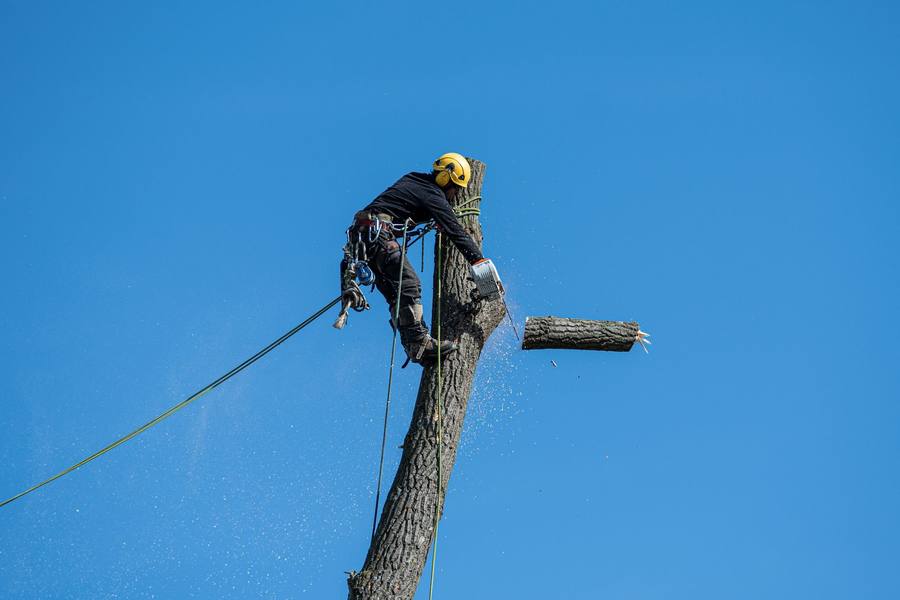
Removal, trimming, and stump grinding cover most of what a Pee Dee property needs, along with storm response when the weather makes the decision for you.
Dead, damaged, and dangerous trees taken down safely, including tight backyard takedowns and full-size pines over structures. Cleanup and haul-off included in the quote.
Deadwood, clearance over roofs and drives, and structural pruning on young trees. Cuts made at the branch collar so the wound actually seals.
Old stumps ground below grade so you can plant, sod, or just mow over the spot without steering around it every week.
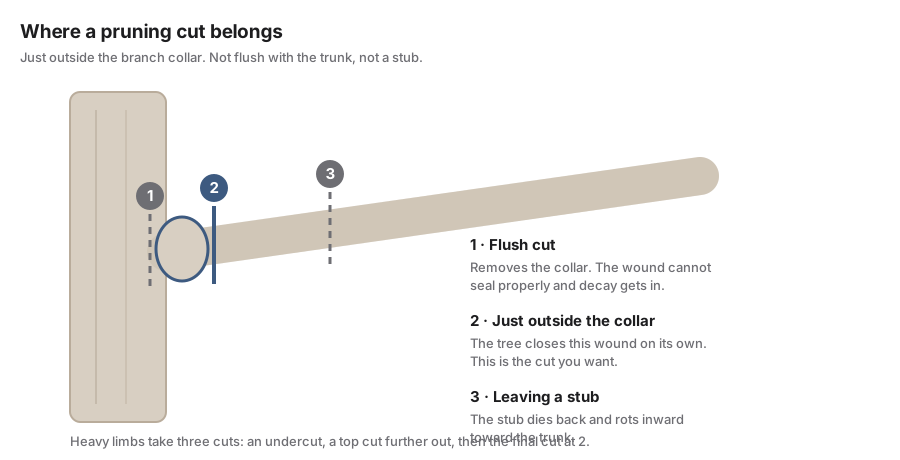
Almost everything that goes wrong with pruning comes down to where the cut lands. At the base of every limb is a slightly swollen ring called the branch collar, and that collar contains the tissue a tree uses to close a wound. Cut just outside it and the tree seals the wound on its own over the following seasons.
Cut flush with the trunk and you have removed the collar along with the limb. The tree cannot close that wound properly, and decay works its way into the trunk instead. Leave a long stub and you get the opposite failure: the stub dies back and rots inward toward the trunk. Both mistakes are common, both are permanent, and neither costs less than doing it correctly.
One more rule worth knowing, because it prevents real damage: a heavy limb comes off in three cuts, not one. An undercut first, then a top cut further out to drop the weight, then the final cut at the collar. Skip that and the falling limb peels a strip of bark down the trunk as it goes.
Loblolly pines are the ones that worry people, and for good reason. They grow tall and fast with relatively shallow root plates, and in saturated ground a sustained wind can push a whole tree over root and all rather than snapping the trunk. That is why pines that stood through decades of ordinary weather sometimes come down in a storm that did not seem worse than the last one - the difference was how wet the ground already was.
Hardwoods fail differently. Live oaks and water oaks tend to shed limbs rather than uproot, and the limbs they shed are usually the ones that were already dead. Sweetgum has its own reputation, mostly earned through weak branch unions and the endless gumballs. Ice is the other regional hazard: an ice event loads every branch with weight the tree never grew to carry, and older neglected canopies come apart first.
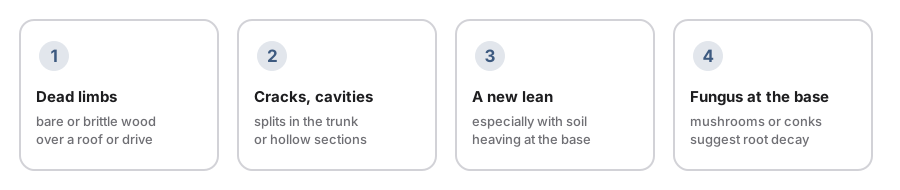
The useful thing to understand is that most failures are visible beforehand. Dead limbs stay in the canopy for years, cracks and cavities open slowly, a lean develops, and mushrooms or conks appear at the base long before anything falls. None of those guarantee failure - plenty of trees carry a cavity for decades - but all of them are worth having someone look at while the weather is calm and the estimate is free.
A few things quietly shorten a tree's life. Topping, which is the worst thing routinely done to trees: cutting the crown back to stubs forces weak regrowth and starts decay at every cut. Piling mulch against the trunk. Trenching or paving through the root zone, which is much wider than most people assume. And leaving storm damage unaddressed, because a torn limb is an open wound.
None of these mean a tree has to come down. All of them are worth an honest set of eyes before the next storm rather than after.
Every job runs the same way, whether it is one limb over a driveway or a stand of pines behind the house.
Somebody looks at the actual tree and puts the number in writing. Cleanup and haul-off are in the removal price, not added afterward.
You get a date and we keep it. If weather moves the schedule - and in this region it will - you hear from us before the day, not after.
Chips cleared, ruts avoided, debris hauled off. A finished job should look like nothing happened except the tree being gone.
Florence sits inland enough to avoid the worst of the surge and close enough that everything coming up the coast still passes through. That geography shapes how tree work runs here: quiet stretches, then a week where every phone in the county rings at once.
The useful work happens before the forecast. A canopy with its deadwood removed and its weak limbs addressed has less to throw at your roof, and a hazardous tree identified in March is a scheduled job rather than an emergency in September. If you have been meaning to have something looked at, the calm season is when both the estimate and the schedule are easiest.
After a storm, priorities sort themselves. Anything on a house, a vehicle, or a power line comes first, and anything touching a power line is a utility call before it is a tree call - not something for a homeowner or a crew to approach. Trees down in open yards are genuinely less urgent even though they look dramatic. A word of caution that applies everywhere after a blow: out-of-town crews appear quickly, and the ones knocking on doors with a truck and no paperwork are worth being skeptical of.
Florence is the base, and the service area covers the surrounding Pee Dee - Darlington, Timmonsville, Effingham, Quinby, Coward, Pamplico, and out toward Lake City. In town that means the mature canopies of Forest Hills, Ashwood Estates, Olde Mill, and The Meadows out in West Florence; past the city limits it means pine stands, fence lines, and acreage.
Travel time is part of the quote on the far edges, and we will tell you that on the phone rather than adding it to the invoice afterward. If you are just outside the list below, it is still worth calling.

Tree work is genuinely dangerous, and it is one of the few home services where hiring badly can leave you holding the liability. So here is the advice worth following regardless of who you call, including us.
Ask for the certificate of insurance, and ask for it to come directly from the insurer rather than as a photocopy. Any legitimate company expects that question and is not bothered by it. If a crew cannot produce coverage and someone is hurt on your property or a limb goes through your roof, that becomes your problem in a way most homeowners never anticipate.
Get the estimate in writing before work starts, and make sure it says explicitly whether cleanup and haul-off are included, because that is the single most common place a verbal quote and a final invoice part company. Be wary of pressure to decide immediately, of large deposits before any work, and of door-knocking crews after a storm. And if someone recommends topping a healthy tree, get another opinion - that is a sign of someone who cuts trees rather than someone who knows them.
Estimates are free and in writing. Removal pricing follows size, species, and above all access - a pine you can drop in an open yard is a different job from the same pine between a house and a fence, and that is why an honest number comes from looking at the tree rather than from a phone description. Trimming prices by scope, and stump grinding by diameter and how many.
Call (555) 555-5555 for removal, trimming, storm cleanup, or stump grinding anywhere in Florence and the Pee Dee. If wind is in the forecast and you have found yourself watching a particular tree, that is worth a call before the forecast turns into a weekend.
Tell us what you need and we'll get back to you with a real answer. If it's an active backup or standing water over the field, calling gets you a faster response.
Call: (555) 555-5555
Area: Florence, SC and Florence County